

Can Image Stabilization On Sony Dsc Hx400v Be Repaired?
Sony DSC-HX400V settings, tips and tricks
Introduction
This is an avant-garde manual for the SONY HX400V with tips and tricks. I'll be going through the unabridged menu system with you and explain you exactly what is what, giving y'all tips on how to setup your photographic camera along the style. The Sony H400V has niggling in common with the older HX300, so you'll run across lots of differences in the menu if you come from that camera. Although the basic features did non change (a ane 2/three BSI CMOS sensor with 20 million pixels and a 50x zoom ranging from 24-1200 mm), several defects take been corrected like a more powerful new Bionz X processor, slightly redesigned optical formula, Wi-Fi and NFC, a new user interface like the Sony RX100 and an accessory hot shoe.
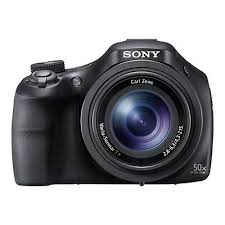
This new menu system might look confusing at first, simply yous'll quickly get the hang of information technology if you spend some time reading this Sony HX400V guide. The Sony manual does offer insights on this, merely to be honest, information technology does not give you a folio by page explanation as I do. And so sit back, read carefully and get fix to learn. If there is a characteristic that you don't desire to tweak or learn, simply skip it and move to the adjacent chapter.
Diving into the Carte system
When you switch on your camera, you lot'll be asked to enter a date, fourth dimension and timezone. This setting is necessary, as all images captured will have a timestamp, making information technology easy to observe your favorite pictures in the futurity.
Afterward this is setup, printing the Menu button. You lot'll see a range of icons and pages.
Nosotros'll starting time at page ane of the camera Icon (camera settings)
(MENU → Camera Settings → page 1)
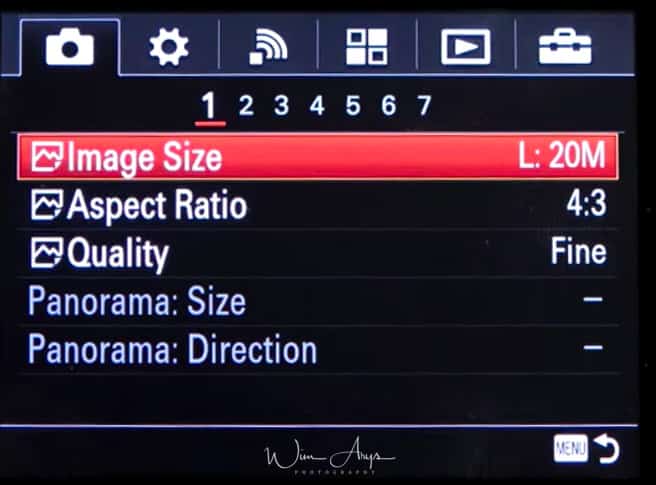
Image size:
The larger the image size, the more detail will be reproduced when the paradigm is saved. The smaller the image size, the more images can exist recorded. Much depend upon the intended use for your images, simply if you tin spare the extra expense of a larger SD menu, I would recommend you to gear up the paradigm size to large.
Knowing the size in pixels at dissimilar aspect ratios and quality levels can tell you how large yous can impress. An A3 print is 3508 pixels 10 4961 pixels, so y'all can comfortably print your images on an A3 paper if you set the Image size to Large. Setting epitome size to medium would correspond to your image filling on a full-screen 4Kmonitor.
The of your image in pixels when Aspect Ratio is 3:2:
- L: 18M 5184×3456 pixels
- M: 8.9M 3648×2432 pixels
- S:: 4.5M 2592×1728 pixels
The size of your image in pixels when Aspect Ratio is iv:3: (RECOMMENDED):
- L: 20M 5184×3888 pixels
- Yard: 10M 3648×2736 pixels
- S: five.0M 2592×1944 pixels
- VGA 640×480 pixels
The size of your paradigm in pixels when Aspect Ratio is sixteen:ix:
- L: 115M 5184×2920 pixels
- M: 7.5M 3648×2056 pixels
- Due south: two.1M 1920×1080 pixels
The size of your image in pixels when Aspect Ratio is 1:1:
- L: 15M 3888×3888 pixels
- M: vii.5M 2736×2736 pixels
- S: 3.7M 1920×1920 pixels
Aspect Ratio
You tin can choose 4:iii (which uses the total sensor surface), 3:ii, 1:1 or 16:ix (crop simply a more wide view). Unless you are not interested in editing your images afterward, leave every bit is at 4:three, you can always crop in a photograph editor. Recall that if you decide to utilise a different aspect ratio, what is cropped out will not be saved.
Quality:
The HX400V is not capable of storing RAW images. RAW basically means that all the information captured by the camera'southward sensor is saved unprocessed.
Instead, this camera saves it as a JPEG file. This Jpeg will have gone through all your settings like added sharpness, dissonance reduction, white remainder, etc as well as being compressed to a certain degree.
You lot have ii compression options available: FINE (larger) and STANDARD (smaller, less quality) which takes up less infinite on your SD menu only is less suited for editing afterward.
I e'er recommend setting Quality to Fine. When you're investing in a skillful camera like this, you don't want to miss out on the fantastic detail in tin can produce.
Panorama size
(But available when in panorama shooting manner on the mode dial) Size is selectable betwixt standard and wide. Wide means your motion picture will embrace a larger area. Set it to standard, having to browse an even broader area when making panoramas will accept some feel with the camera to do efficiently.
Size is selectable between standard and wide. Wide means your picture volition cover a larger expanse. Set up it to standard, having to scan an even broader area when making panoramas volition take some feel with the camera to do efficiently.
Set up information technology to standard, having to browse an even broader area when making panoramas volition take some experience with the camera to do efficiently.
Panorama direction
A panorama picture is a composite of several images stitched together. When in this mode, you'll run across an arrow that guides you in what management and speed you should pan the camera to take the sequential images that will be stitched together. You can cull the path in this menu (either, upwardly, down, left or right).
Yous tin make panoramas while scanning your camera up-down or left-right.So what is this all about? This might sound confusing at showtime, but this comes down to how you concord the Sony DSC-HX400V when shooting panoramas: either in portrait or landscape orientation.
(Bill of fare → Camera Settings → page ii)
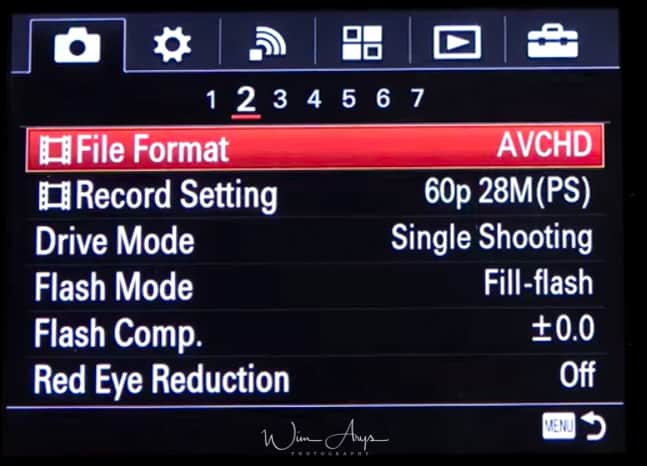
File format (for movies)
Selects the movie file format.
- AVCHD: Records Hard disk movies in AVCHD format. This file format is suitable for high-definition Television receiver. Sound: Dolby Digital
- MP4: Records mp4 (AVC) movies. This format is suitable for playback on smartphones or tablets, web uploads, email attachments, etc. Sound: AAC.
Tape setting (besides a movie setting)
You can choose the quality of recorded video here. You can change the image size, frame charge per unit, and image quality for movie recording. The higher the bitrate, the college the image quality. If you're not familiar with this, leave as is.
When File Format is gear up to AVCHD:
- 60i/50i: Movies are recorded at approximately 60 fields/sec (for 1080 60i-compatible devices) or 50 fields/sec (for 1080 50i-compatible devices), in interlaced mode, with Dolby Digital audio, in AVCHD format.
- 24p/25p: Movies are recorded at approximately 24 frames/sec (for 1080 60i-compatible devices) or 25 frames/sec (for 1080 50i-compatible devices), in progressive mode, with Dolby Digital sound, in AVCHD format.
- 60p/50p: Movies are recorded at approximately 60 frames/sec (for 1080 60i-compatible devices) or fifty frames/sec (for 1080 50i-compatible devices), in progressive way, with Dolby Digital audio, in AVCHD format.
When File Format is set to MP4:
- Movies shot are recorded in MPEG-four format, at approximately 60 frames/sec (for 1080 60icompatible devices), approximately 50 frames/sec (for 1080 50i-uniform devices), approximately thirty frames/sec (for 1080 60i-compatible devices) or approximately 25 frames/sec (for 1080 50i-compatible devices), in progressive mode, with AAC audio, MP4 format.
Menu items details: Settings also depend on your isterion setting PAL/NTSC
When File Format is set to AVCHD:
- 60i/50i 24M(FX): 50i 24M(FX: Records loftier image quality movies of 1920 × 1080 (60i/50i). Bit-rate: Approx. 24 Mbps (Max.)
- 60i/50i 17M(FH) (default setting)*: 50i 17M(FH) (default setting): Records standard image quality movies of 1920 × 1080 (60i/50i). Bit-charge per unit: Approx. 17 Mbps (Avg.)
- 60p/50p 28M(PS): Records the highest image quality movies of 1920 × 1080 (60p/50p). Bit-rate: Approx. 28 Mbps (Max.)
- 50p 28M(PS): Records the highest image quality movies of 1920 × 1080 (60p/50p). Scrap-rate: Approx. 28 Mbps (Max.)
- 24p/25p 24M(FX): 25p 24M(FX)**: Records high image quality movies of 1920 × 1080 (24p/25p). This produces a cinema-similar atmosphere. Bit-rate: Approx. 24 Mbps (Max.)
- 24p/25p 17M(FH): 25p 17M(FH)**: Records standard epitome quality movies of 1920 × 1080 (24p/25p). This produces a movie theater-like atmosphere. Flake-rate: Approx. 17 Mbps (Avg.)
When File Format is set to MP4:
- 1440×1080 12M (default setting): Records movies of 1440 × 1080. Bit-rate: Approx. 12 Mbps (Avg.)
- VGA 3M: Records movies of VGA size. Bit-rate: Average 3 Mbps.
General notes:
- 60p/50p movies tin be played back only on uniform devices.
- Movies recorded with the [60p 28M(PS)]/[50p 28M(PS)]/[60i 24M(FX)]/[50i 24M(FX)]/ [24p 24M(FX)] /[25p 24M(FX)] setting in [ Tape Setting] are converted by PlayMemories Home in order to create an AVCHD recording disc. This conversion can accept a long time. Likewise, you cannot create a disc in the original epitome quality. If yous want to keep the original image quality, shop your movies on a Blu-ray Disc.
- To play back60p/50p/24p/25p movies on a Boob tube, the TV must exist compatible with those formats. If the TV is not compatible with the 24p/25p format, 24p/25p movies volition be output as 60i/50i movies.
Bulldoze Mode
You can set the bulldoze style, such as continuous or cocky-timer shooting.
- Single Shooting (default setting): Shoots ane nevertheless image. Normal shooting mode.
- Cont. Shooting: Shoots images continuously while y'all press and concur downwardly the shutter push. Hi: takes nigh ten images per second, Lo about iii.
- Cocky-timer: Shoots an prototype afterwards 10 or ii seconds. (selectable in sub menu) You lot tin change the bending of the LCD screen and shoot images while monitoring the image on the screen.
- Self-Portrait: When the HX400V detects the number of faces you have selected, a beep will sound and the shooting starts later on two seconds.
- Self-timer(Cont): Shoots a specified number of images continuously subsequently 10, v or seconds or 2 seconds (selectable in the sub menu).
- Cont. Subclass: Shoots images while holding the shutter button down, each with different degrees of brightness. (3 images betwixt .three and iii EV difference, selectable in the sub menu.) For processing equally HDR on your PC.
- WB bracket: Shoots a total of three images, each with a dissimilar colour tone according to the selected settings for white residual, color temperature, and the color filter. (3 images with either LO small changes or Howdy large changes)
Flash Mode
Flash off;
obvious
Autoflash:
The flash works in dark environments or when shooting towards a bright calorie-free.
Fill-flash:
The flash works every time you trigger the shutter.
Slow sync:
Tells the camera to employ a longer shutter speed along with a flash, and thus is meliorate for night shots. In transmission and shutter priority modes, there is no divergence in flash ability. But when using aperture priority, programme, or auto, choosing slow sync tells the camera to use a longer shutter speed than it would normally pick.What the slow sync wink manner actual does is first burn the flash for the subject exposure, then allow for a longer shutter speed that will allow for more ambient light to be captured by the sensor.
Advanced Wink:
The flash automatically operates in dark locations or when there is backlighting. In dark locations, the upper limit value of the ISO sensitivity increases in order to maximize the flash range.
Rear Sync:
Capturing an image involves two shutter actions: one when the capture starts and on when it stops. Rear Sync tells the flash to fire right earlier the shutter closes. Moving objects will testify a streak where they came from and a sharp image where they were at the terminate of the exposure. This conveys a sense of speed with moving objects. Rear Sync is a creative technique, if you'd similar to know more well-nigh this type of photography, I'd suggest doing a Google search on 'Rear Sync Flash Photography.'
Wireless:
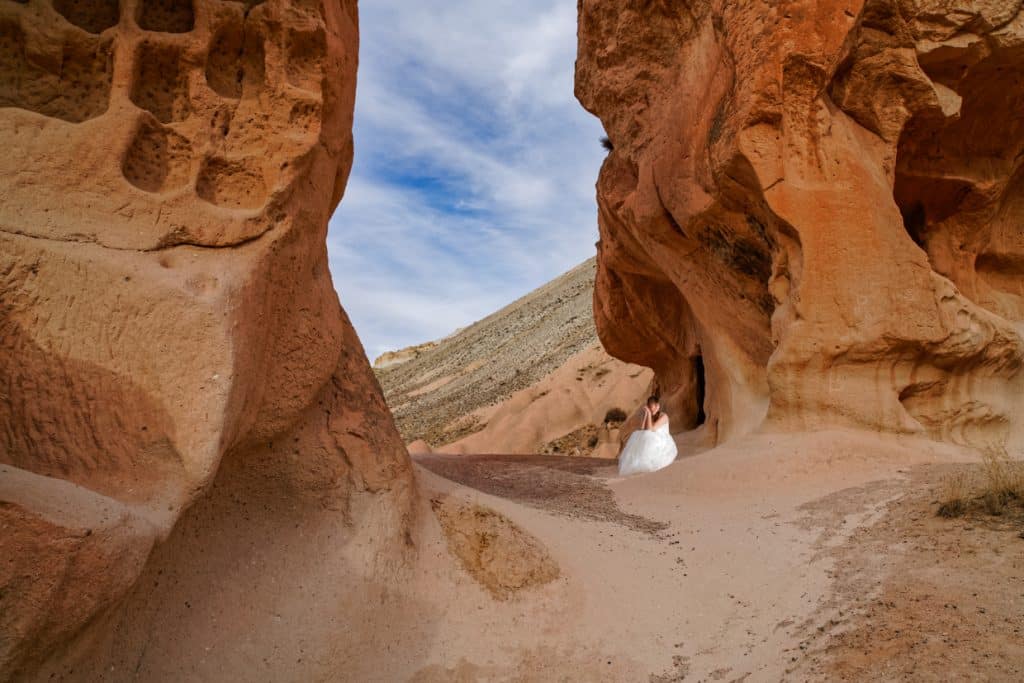
When using a wireless flash, the shading effect provides a more 3D appearance to a subject field than when using an attached flash. This mode is constructive when you adhere a remote control-compatible external flash sold separately to the camera, and shoot with a wireless wink, placed away from the product. If you're looking for a suitable flash, yous'll need i that corresponds to the Sony MIS (multi-interface shoe). If you want to salve some money, have a look at brands like Godox or Neewer.
Flash compensation:
Adjusts the amount of flash light in a range of –2.0 EV to +2.0 EV. Flash compensation changes the amount of flash calorie-free only. Exposure compensation changes the amount of wink light forth with the modify of the shutter speed and aperture.
Especially when using Wearisome Sync or Rear Sync Flash modes, y'all might have to lower the power of the Flash to become a decently exposed image.
Red Eye Reduction:
This anti-Red Eye setting quickly fires the flash before your prototype capture starts, reducing the red-middle effect ofttimes seen when using the wink.
(MENU → Camera Settings → page 3)
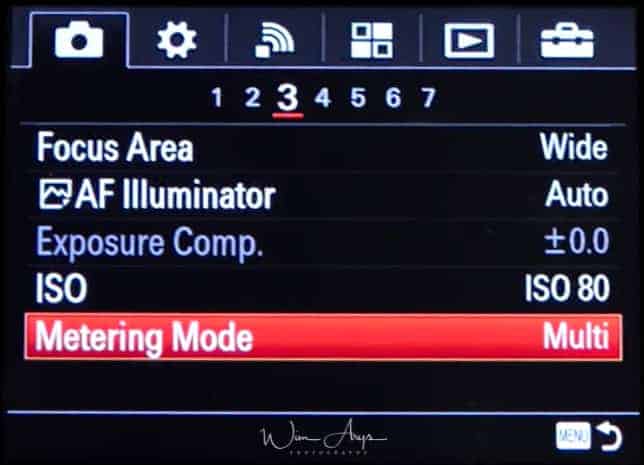
Focus expanse
You might think information technology is best to leave information technology on the manufacturing plant 'wide' setting (as this uses all AF points), but for certain scenes, it is often better to use a zone or flexible spot to go it to focus on what you want.
Wide:
Broad focus area uses all focus points on the sensor. Ideal for action scenes where there is a lot of movement going on in your frame.
Eye:
Focusses on whatever is centered in your images. A fail-proof way of getting the camera to focus on what yous want. If you accept any issues using the autofocus and are in a state of affairs where you lot don't want to miss any shots, revert to Center and just make certain you lot have your subject centered.
Flexible spot:
Flexible spot surface area selects a spot anywhere on the screen where the camera should focus. (similar to Center spot, except not.. in the centre) You tin ready it to pocket-size, medium or large. If y'all want to use this focus area, prepare it to medium or large, as the camera will struggle to find focus when set to pocket-size (except perhaps for close-up portraits where you'd desire to focus on the iris of the middle)
Focus Lock:
Shoots images with the focus locked on the desired subject in motorcar focus mode.
- Fix the zoom/focus switch to AF/ZOOM.
- Place the field of study within the AF area and printing the shutter button halfway down. The focus is locked.
- Keep pressing the shutter button halfway downwards, and place the subject back in the original position to re-etch the shot.
- Press the shutter button down fully to take the picture.
AF Illuminator:
The AF illuminator is a little cherry-red light allowing the camera to focus more hands when the shutter push button is pressed halfway. It automatically is switched off when you fully press the shutter. Leave it on.
Exposure Comp
If you lot find that your prototype is overexposed (for instance when yous are shooting at large apertures for a shallow depth-of-field in bright daylight), you can tweak the exposure compensation here in a plus or minus ii (exact EV dependent on adjacent step) range.
ISO
You can select at which ISO value you'd similar to capture your paradigm or alter the AutoISO range
I have this range set betwixt lxxx-800 as this range is nigh noise complimentary, and I don't like the ISO performance in a higher place 1600. When shooting in depression light, you might think of using a college peak value (factory setting goes up to 3200).
Tip: Autofocus will besides work better at college ISO.
Metering Mode
Metering mode refers to the way the camera reads the calorie-free and sets the exposure.
In multi, information technology considers the whole frame and sets exposure according to internal algorithms programmed in camera.
In spot or center, the photographic camera merely considers what is in that spot or the middle (per instance, if your subject is completely black, the camera volition try to compensate by overexposing the image).
If you like dark or moody portraits, try setting Metering Mode to Spot or Center, and brand certain your subjects face is centrally positioned in the frame. Y'all'll come across that the exposure will be more suitable for the face than when set to Multi.
(MENU → Camera Settings → page four)
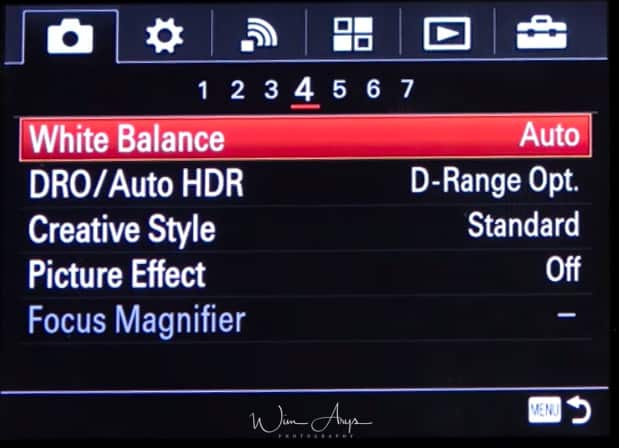
White Balance
Yous tin can either:
- Auto (default setting): The production automatically detects the low-cal source and adjusts the color tones.
- Daylight: The color tones are adjusted for the daylight. Shade: The color tones are adapted for shadiness.
- Cloudy: The color temperature is adjusted for a cloudy sky. Incandescent: The colour temperature is adjusted for places under an incandescent lamp, or under brilliant lightings, such as in a photograph studio.
- Incandescent: The color temperature is adapted for places under an incandescent lamp, or under bright lights, such as in a photo studio.
- Fluor.: Cool White: The color temperature is adjusted for white fluorescent lighting.
- Fluor.: Solar day White: The color temperature is adapted for neutral white fluorescent lighting.
- Fluor.: Daylight: The color temperature is adjusted for daylight fluorescent lighting.
- Flash: The color temperature is adjusted for a wink.
- C.Temp./Filter: Adjusts the color tones depending on the light source. Achieves the event of CC (Color Bounty) filters for photography.
- Custom: Uses the white remainder setting saved in [Custom Setup].
- Custom Setup: Memorizes the bones white color under the light conditions for the shooting environment.
DRO/Motorcar HDR
DRO:
This stands for Dynamic range optimize and analyses the contrast of your scene in real-time. It produces an image with optimal effulgence and recovered shadow item. You can use this function even while the subject field is moving or during the continuous shooting.
- D-Range Optimizer: Auto (default setting): Corrects the brightness automatically.
- D-Range Optimizer: Lv1 ― D-Range Optimizer: Lv5: Optimizes the gradation of a recorded image for each divided area. Select the optimization level from Lv1 (weak) to Lv5 (stiff)
Auto HDR:
This feature Shoots three images with dissimilar exposures and then overlays the bright area of the underexposed image and the dark area of the over exposed image to create a flick with an extended range from highlight to shadow.
The highlight detail in auto HDR is better than that in DRO and with reduced noise. The shutter is released three times, then using this function for moving subjects is not recommended.
- Auto HDR: Exposure Diff. Auto (default setting): Corrects the exposure difference automatically. Motorcar HDR: Exposure Diff. 1.0EV ―
- Auto HDR: Exposure Diff. 6.0EV: Sets the exposure difference, based on the contrast of the subject. Select the optimal level between 1.0 EV (weak) and 6.0 EV (strong). For example, if yous set the exposure value to 2.0 EV, three images will be composed of the following exposure levels; −1.0 EV, optimal exposure, and +1.0 EV
Creative Fashion
This menu setting allows you to select the desired image processing. Y'all tin adjust exposure (shutter speed and aperture) as you like with [Artistic Style], unlike with [Scene Selection] where the product adjusts the exposure.
- Standard (default setting): For shooting various scenes with rich gradation and cute colors.
- Vivid: The saturation and contrast are heightened for shooting hit images of colorful scenes and subjects such equally flowers, spring greenery, bluish sky, or sea views.
- Portrait: For shooting the skin color in a soft tone, ideally suited for shooting portraits.
- Landscape: The saturation, dissimilarity, and sharpness are heightened for shooting vivid and crisp scenery. Distant landscapes besides stand out more.
- Sunset: For shooting the cute red of the setting sun.
- Blackness & White: For shooting images in black and white monotone.
- Sepia: For shooting images in sepia monotone.
Contrast, Saturation, and Sharpness can be adapted for each Creative Style item. Select an item to be set by pressing the right/left side of the control wheel, then prepare the value using the acme/bottom side of the command wheel.
- Dissimilarity: The higher the value selected, the more the difference of light and shadow is accentuated, and the bigger the effect on the image.
- Saturation: The college the value selected, the more than vivid the color. When a lower value is selected, the color of the image is restrained and subdued.
- Sharpness: Adjusts the sharpness. The higher the value selected, the more the contours are accentuated, and the lower the value selected, the more the contours are softened.
Picture Effect
Think of this menu as an Instagram app right in your camera, with all kinds of retro filters and effects. These are but available when quality is ready to Jpeg (Not in RAW). You lot can perform detailed settings for some of the furnishings by using the left/right side of the control wheel.
- Off (default setting): Disables the Moving picture Event function.
- Toy Camera: Creates a soft paradigm with shaded corners and reduced sharpness.
- Pop Color: Creates a bright look by emphasizing color tones.
- Posterization: Creates a high dissimilarity, abstract look past heavily emphasizing primary colors, or in black and white.
- Retro Photo: Creates the await of an anile photo with sepia colour tones and faded dissimilarity.
- Soft Loftier-central: Creates an epitome with the indicated atmosphere: bright, transparent, ethereal, tender, soft.
- Partial Colour: Creates an image which retains a specific color, but converts others to blackness and white.
- High Dissimilarity Mono.: Creates a loftier-contrast image in black and white.
- Soft Focus: Creates an image filled with a soft lighting consequence.
- HDR Painting: Creates the look of a painting, enhancing the colors and details.
- Rich-tone Mono.: Creates an image in black and white with rich gradation and reproduction of details.
- Miniature: Creates an image which enhances the subject vividly, with the background defocused considerably. This effect may often be found in pictures of miniature models.
- Watercolor: Creates an prototype with ink drain and blurring furnishings as if painted using watercolors.
- Illustration: Creates an illustration-like paradigm by emphasizing the outlines.
Focus Magnifier
Another quite handy feature if y'all want to check if your epitome is in focus. It means that you lot can bank check the focus by enlarging the image before shooting. Great for shooting in transmission focus or DMF. You can besides set how long the magnified image volition be shown in the Focus Magnif. Fourth dimension setting. (custom settings).
Press on the centre of the command bicycle to enlarge the paradigm and select the position you desire to overstate using up/downwardly/left/right side of the control wheel. You tin change the magnifier scaling in two steps by pressing in the center, and shut the focus magnifier mode and return to the normal shooting display by pressing iii times
You tin change the magnifier scaling in two steps past pressing in the center, and close the focus magnifier mode and render to the normal shooting brandish by pressing three times.
(MENU → Camera Settings → page 5)
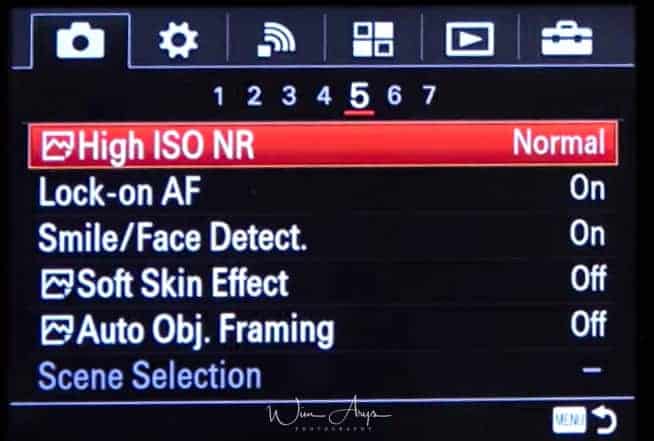
If you've stumbled on my guide trying to find where to turn on Long Exposure noise reduction, I'll have to disappoint y'all. Although one on the most requested features, the DSC-HQ90V does not have this functionality.
High ISO NR
Hither you can select the amount of noise reduction practical to images with high ISO settings (when quality is set to jpeg). Equally Sony has rather ambitious racket reduction, I would chance it to Depression. (if not, you run the risk of getting paint-like, smeared images at higher ISO values)
Lock-on AF
This is a very powerful autofocus feature. When turned ON, it allows you to rail a subject field. In the iAuto mode, y'all tin can access this characteristic (when turned ON and the camera is set up to AF) by pressing the Center button of the multi-controller. Yous'll see a square on your screen, then heart your desired tracking subject and the camera will go along to track it, even when it exits your frame and reappears.
Smiling/Face Find
This is some other powerful characteristic. It tin can be set to automatically detect on focus on faces and enable a function called Grinning Shutter. When the latter is enabled, the camera will automatically capture an paradigm when a smile is detected. Did I hear y'all say Selfie? Yes, it's the ultimate selfie tool.
Soft peel effect
Sets the effect used for shooting the skin smoothly in the Face Detection function. I don't like the results, so on my camera, it is turned off.
Machine Object Framing
When enabled, the Sony HX400V will automatically crop your captured paradigm to what information technology deems best. Significant information technology volition cut the picture for a nicer limerick. A nice characteristic if you don't desire to carp too much with the technical side of photography.
Scene Selection
Allows you lot to shoot with preset settings according to the scene.
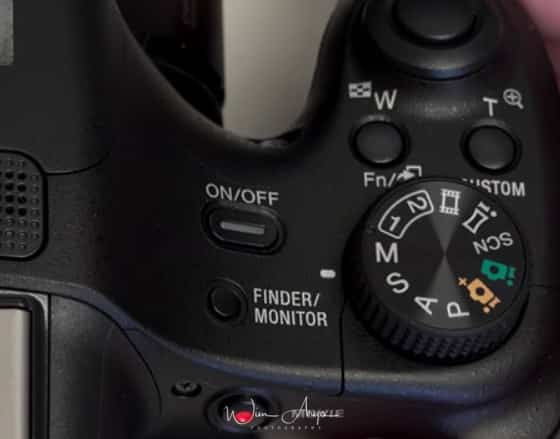
- Set the mode punch to SCN (Scene Selection).
- MENU → (Camera Settings) → [Scene Selection SCN] → desired mode. When [Style Punch Guide] is set to [On], you lot tin can select the desired settings later you accept changed the position of the style dial.
These presets are available:
- Portrait: Blurs background and sharpens the field of study. Accentuates the skin tones softly.
- Adv.Sports Shooting: Allows you to shoot subjects with fast movements, such every bit sports. While the shutter is pressed halfway, the movement of the subject is predicted and the focus will be adjusted.
- Mural: Shoots the entire range of a scenery in sharp focus with vivid colors.
- Night Scene: Shoots night scenes without losing the dark temper.
- Hand-held Twilight: Shoots nighttime scenes with less racket and blur without using a tripod. A burst of shots are taken, and image processing is applied to reduce discipline blur, photographic camera shake, and noise.
- Night Portrait: Shoots night scene portraits using the wink.
- Anti Motion Blur: Allows you to shoot indoor shots without using the flash and reduces subject field mistiness. The production shoots burst images and combines them to create the image, reducing subject blur and racket.
- Pet: Allows you to shoot images of your pet with the best settings.
- Gourmet: Allows you to shoot food arrangements in succulent and bright colors.
- Beach: Allows yous to shoot scenes on the beach in bright and vivid colors even under the sunlight.
- Snow: Allows you to shoot clear images, preventing sunken colors in snowy scenes or other places where the whole screen appears white.
- Fireworks: Allows y'all to shoot images of fireworks in all their splendor.
- Soft Pare: Allows you to shoot images of faces with a smoother wait.
- Loftier Sensitivity: Allows you to shoot however images even in dark locations without using the flash, and reduces discipline blur. Also allows you to shoot dark movie scenes more brightly.
(MENU → Photographic camera Settings → page 6)
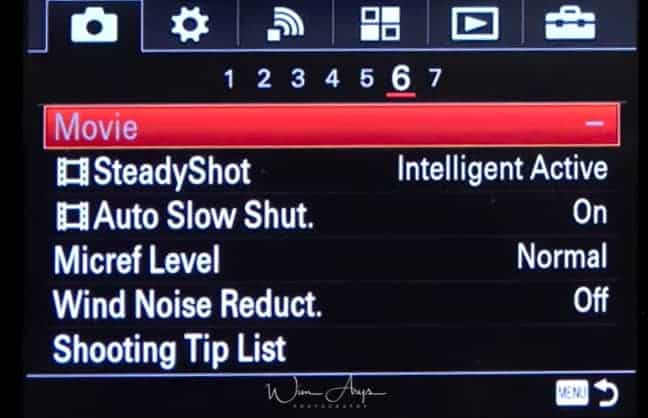
Movie
Y'all tin adjust the shutter speed or aperture value to your desired settings for recording movies. You can also cheque the paradigm bending earlier shooting.
- Program Auto: Allows you to shoot with the exposure adapted automatically (both the shutter speed and the aperture value).
- Aperture Priority: Allows you to shoot later on adjusting the aperture value manually.
- Shutter Priority: Allows you to shoot subsequently adjusting the shutter speed manually.
- Manual Exposure: Allows you to shoot subsequently adjusting the exposure (both the shutter speed and the aperture value) manually
SteadyShot (for movies)
Sets SteadyShot when shooting movies.
Hither you have three options:
- Intelligent Active: Provides the most powerful SteadyShot effect. I ready it to this.
- Agile (default setting): Provides a more than powerful SteadyShot outcome.
- Standard: Reduces camera shake under stable movie shooting condition.
Machine slow close. (also a moving-picture show setting)
Sets whether or not to conform the shutter speed automatically when recording movies if the subject is dark. Less light always means a longer shutter time in order to get a correct exposure. As when shooting stills, you might get some blur when you use this characteristic.
On: The shutter speed automatically slows when recording in nighttime locations. You lot can reduce racket in the moving picture by using a slow shutter speed when recording in the nighttime.
Off: The recorded movie will exist darker than when On is selected, but you can record movies with smoother motility and less object blur.
Micref Level
You lot tin select the microphone level for moving picture recording to Normal (for dialogue) or Depression (for concerts etc).
Current of air noise reduct.
Sets whether or not to reduce current of air racket during movie recording.
Shooting tip listing
This setting basically turns the on-screen shooting tips on or off. If you're non fully comfy with the photographic camera, this is an excellent tool in order to go acquainted with all the functions and settings. Once information technology starts getting on your nerves, it means yous know enough to turn it off :).
(Bill of fare → Camera Settings → page 7)
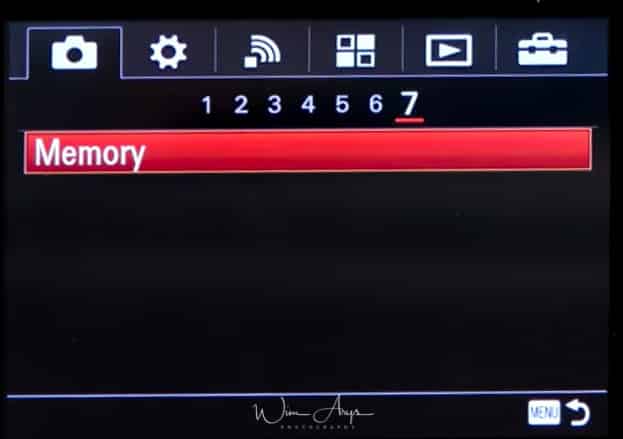
Memory
Allows you to register upwards to 3 often-used modes or production settings in the product. You tin can recollect the settings using simply the mode dial.
Items that tin exist registered:
- Shooting way
- Aperture (F number)
- Shutter speed
- Camera Settings
- Optical zoom scale
To recall registered settings: Set the mode punch to MR, so press the correct/left side of the command cycle or turn the command wheel to select the desired memory number.
To modify registered settings: Change the setting to the desired i and re-register the setting to the aforementioned mode number
(Card → Custom settings (wheel) → page 1)
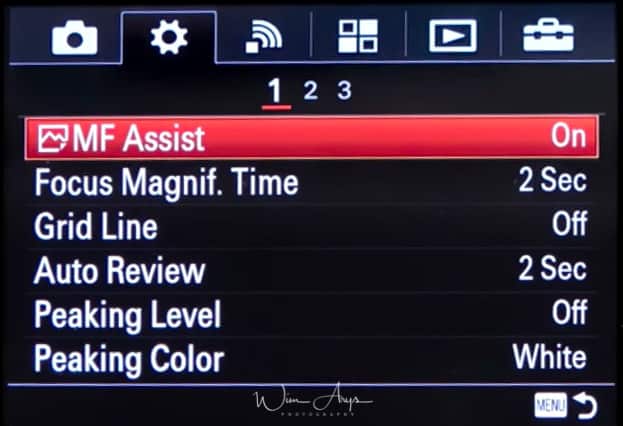
MF assist
This works in conjunction with the Focus Magnifier on Page 5 of the photographic camera settings. You might remember that you lot tin select the area to magnify there when using manual focus (MF). MF assist will need to exist turned on if you lot want to use this feature.
Focus Magnif Time
You lot can set up how long to hold the magnified expanse during MF assist. 2 sec, v seconds or no limit.
Two seconds is how I take it gear up.
Filigree Line
Having a filigree line on your screen is a helpful adjutant for the composition of your prototype.
The human being encephalon is hard-wired to recognize the construction, and virtually people observe a well-composed image more eye-pleasing.
During photography history, rules take been developed on how to compose the different elements all-time within a scene. Many landscapes you'll see have the horizon run through the middle of the prototype for instance, but this is just composition in its simplest form. Many photographers with a thorough understanding of these techniques go far beyond that.
A good starting point is using the in-camera grid to make your brain aware of the possibilities in limerick.
The Rules of 3rds, Foursquare and Diag +square are available in the Sony HX400V.
Auto Review
Select the amount of time the camera displays your epitome directly later on capturing the image. 10, five and 2 sec is bachelor, or you tin can turn this feature OFF if information technology annoys you.
Peaking Level
- Peaking Level is a manual focusing help that works when you have your camera set to MF or DMF.
- Yous'll see a type of noise outlining the parts of your epitome where the focus lies; you can adjust the sensitivity to high, mid or low.
- Which setting is best depends on what lens you use, as with a sharper lens it can be configured to low, while more soft lenses benefit from a medium or high setting to conspicuously visualize what you're focusing on.
Peaking Color
Y'all can choose the colour of this Peaking betwixt Cerise, white and yellowish. I have it ready to carmine, as this contrasts nicely with almost scenes you capture.
MENU – Custom Settings – page two
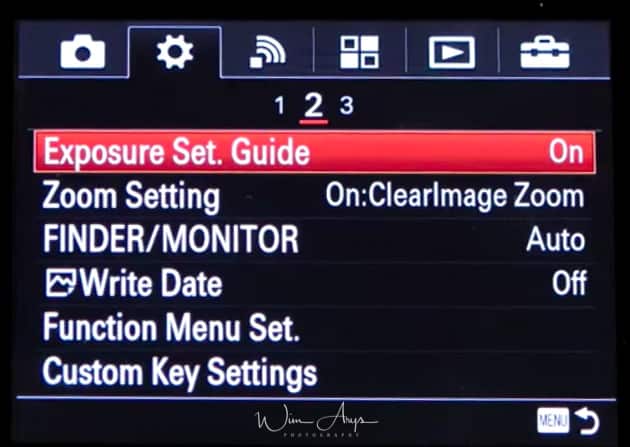
Exposure set guide
Sets the guide displayed when exposure settings are changed in the shooting screen. First-class tool when you're getting to know the functionality of your new camera. If yous're familiar with Sony'south characteristic, turn it OFF.
Zoom setting
Set to Optical zoom simply, using the optical zoom capabilities of your lens. If yous prepare this to digital zoom, the photographic camera will exist basically cropping pixels out.
Finder/Monitor
Sets the method for switching the brandish betwixt Electronic Viewfinder and the screen.
- Motorcar (default setting): When you look into the Electronic Viewfinder, the display is switched to the Electronic Viewfinder automatically.
- Viewfinder: Switch between the Electronic Viewfinder brandish and the screen display by pushing up/down the popular-up finder. When the Electronic Viewfinder is pushed down, the image is displayed just on the screen. When the Electronic Viewfinder is pushed upwardly, the screen is turned off and the paradigm is displayed only in the Electronic Viewfinder.
Write Date
Sets whether to tape a shooting date on the still prototype. Remember that you won't exist able to delete the appointment postage on your image if information technology is turned On.
Function carte du jour set
You can assign the functions to exist chosen up when you press the Fn (Office) button.
Custom keys setting
Assigning functions to the diverse keys allows you to speed up operations by pressing the appropriate key when the shooting information screen is displayed.
Carte – Custom Settings – folio 3
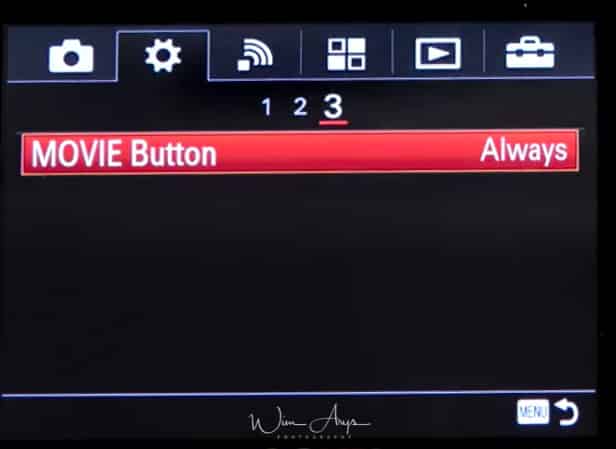
Flick push
Sets whether or non to actuate the Pic button.
- Always (default setting): Starts pic recording when y'all press the Moving picture push in any manner.
- Movie Style Just: Starts pic recording when you press the MOVIE button merely if the shooting mode is set to Movie mode.
Menu – Wireless functionality – page 1
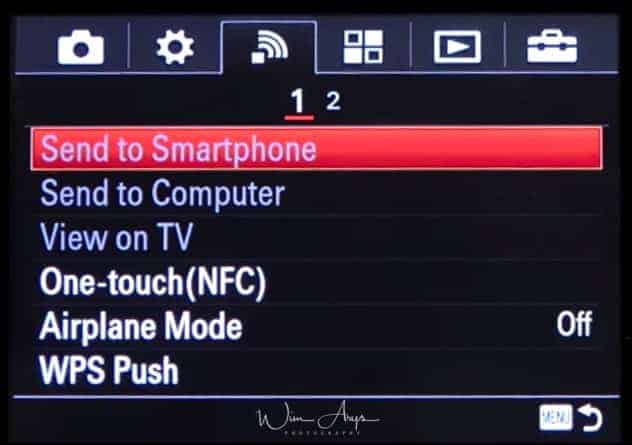
Ship To Smartphone
- Yous can send ane or several images direct to your wireless device (phone or tablet) by pressing this push button.
- Y'all can either decide to choose which images yous want to transfer on the camera or on the wireless device (via the Sony PlayMemories app, bachelor for free in the apple or android store).
- You'll have to connect the camera via Wifi beginning (it makes a Wifi admission indicate), using the education on the Sony DSC-HX400V screen.
- It works just like connecting to any other access point with your phone or tablet.
- You should exercise this as rapidly equally possible, just to get information technology out of the manner.
- When your phone has wirelessly connected to the camera in one case, and you've entered the countersign, it volition call up this, and make information technology a lot faster to connect later.
Ship to Reckoner
You'll need to physically connect the calculator to the photographic camera using the supplied USB cable, and yous can button selected pictures to your Sony PlayMemories desktop software (installed from the CD or downloaded from their website). This tin even be fix up to proceed pushing images afterwards the camera has turned off.
View On TV
If you lot accept a Wifi-enabled Telly, you can view images and slideshows directly from your camera through your dwelling house wireless network.
One Affect NFC
Enables Quick, one-touch connectedness (as opposed to starting time accessing the camera's wireless network then navigating to the Playmemories app) with NFC (nearly-field advice) capable devices.
I have not tried this (as my iPhone does not have NFC) but it looks a lot easier to utilize.
Airplane Style
Disables all wireless functionality, merely like aeroplane mode does on your telephone.
WPS Button
If your access point has the WPS button, you can register the access point to the photographic camera easily past pushing the WPS button.
MENU – Wireless functionality – folio ii
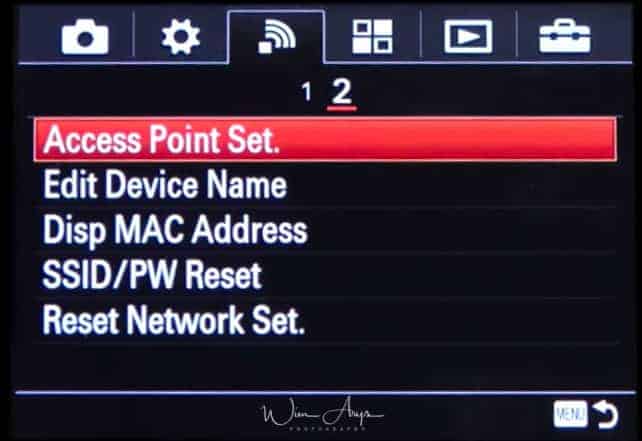
Access Betoken Set
Here you tin setup an access point for your camera to the net.
It enables the Sony DSC-HX400V to install PlayMemories apps from the internet directly. Works just like setting an access betoken (WiFi connection) on your phone.
Edit Device name
If you wish, you can modify the name of the Device Access indicate perhaps to make it easier to identify which A6000 is yours in certain situations.
Disp MAC. address
Displays the MAC address of your Sony DSC-HX400V.
SSID/PW reset
The Sony DSC-HX400V shares the connection data for Transport to Smartphone and Smart Remote Embedded with a device that has permission to connect. If you desire to change the device that is permitted to connect, reset the connection information.
Reset Network set up
Resets all the network settings to default settings.
MENU – Playmemories settings- page one
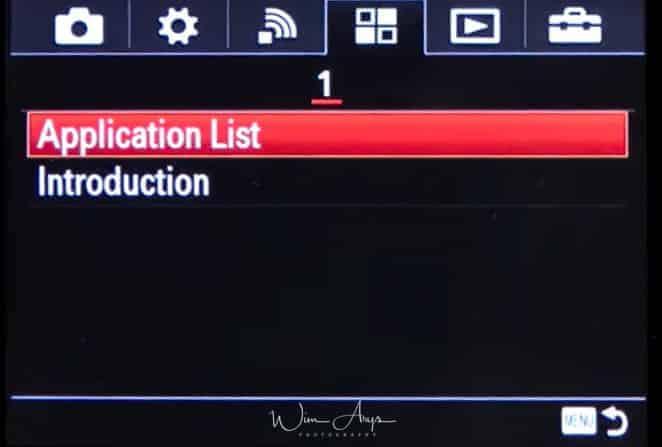
Application List
You'll detect The Smart remote control photographic camera app (wich allows y'all to utilize your telephone as a remote control via PlayMemories phone app for iPhone and Android) and the Playmemories Camera app hither.
Y'all can admission your online PlayMemories business relationship here, or create an account (once you've ready your camera connection with your Wifi network).
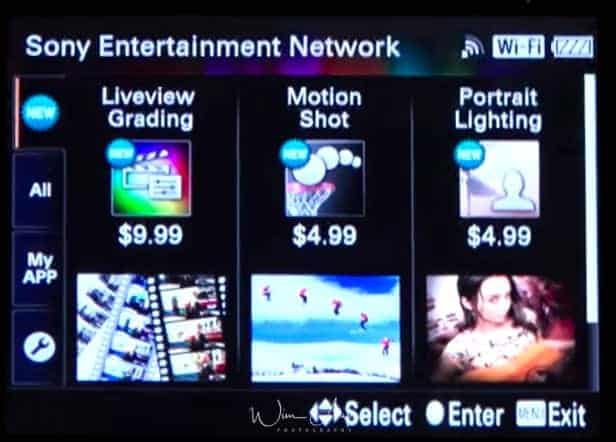
You'll also be able to download new apps available for purchase in the Sony Playmemories online app store like the Fourth dimension-lapse and shine reflection app.
If you exercise not want to connect your camera to the internet, you tin ever install new apps (and updates) if you connect the camera to your Mac or PC with the supplied USB cablevision, using the Sony PlayMemories desktop application.
Introduction
You'll find information well-nigh the service and bachelor countries and regions here.
Card – playback options – page ane
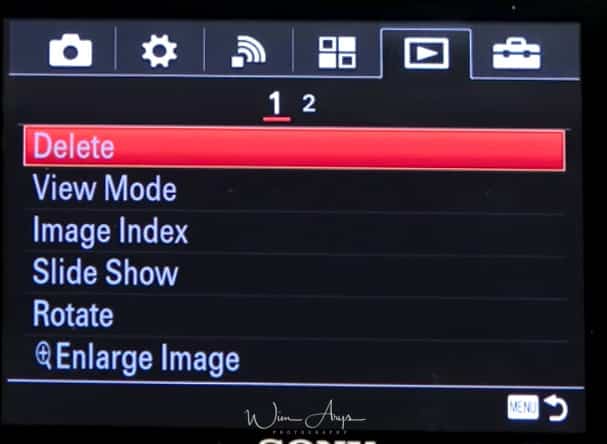
Delete
Delete on or multiple images stored on your SD card.
View Way
select how the camera volition arrange captured images in the viewing browser.
Epitome Index
Select whether y'all want the image browser to brandish 12 (larger) or thirty (smaller) images per page.
Slide Bear witness
Select whether you desire the photographic camera to repeat slideshows when all pictures are viewed or non, and choose the interval between slides.
Rotate
Modify the orientation of images in-camera.
Enlarge Image
Select an paradigm and enlarge a portion of that epitome. Useful for checking details and focus.
MENU – playback options – page 2
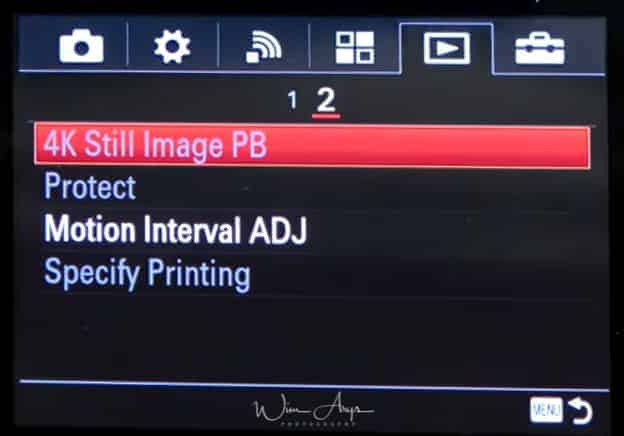
4K Still Epitome Atomic number 82
Outputs still images in 4K resolution to an HDMI-connected TV that supports 4K.
Protect
Protect images (selectable or per appointment) from accidentally being erased.
Motion Interval ADJ
Change the interval of the image tracking of the subject area's motion in loftier-speed, similar a stroboscopic image.
Specify Printing
Specify Printing is a feature that allows images to be marked for printing later. Registered images are displayed with the DPOF mark. (DPOF stands for Digital Print Order Format)
MENU – Setup – page 1
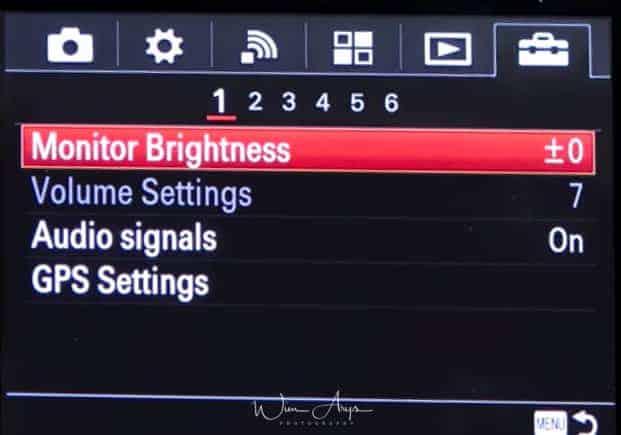
Monitor Brightness
Manually set up the Monitor brightness (recommended leave to zero) or modify to a brighter setting for Sunny Weather.
Volume settings
Change the playback volume for recorded video or demos.
Audio Signals
You lot tin turn off audio signals like the beep when te camera achieves focus. Useful if you desire a more stealthy operation (although you lot'll still hear the 2nd curtain shutter).
GPS signals
You tin record the location information with the images when the built-in GPS sensor of this production can acquire the location data. Using the software PlayMemories Domicile, you lot tin can import the images recorded with the location information to a figurer and enjoy viewing them on a map which shows their shooting location. Refer to the Assistance of PlayMemories Home for details.
- On: The GPS function is activated.
- Off: The GPS function is turned off. The condition icon on the screen may differ depending on the weather condition of the signals emitted from the satellites.
- No icon is displayed: GPS is set to Off or an error has occurred.
Carte du jour – Setup – folio two
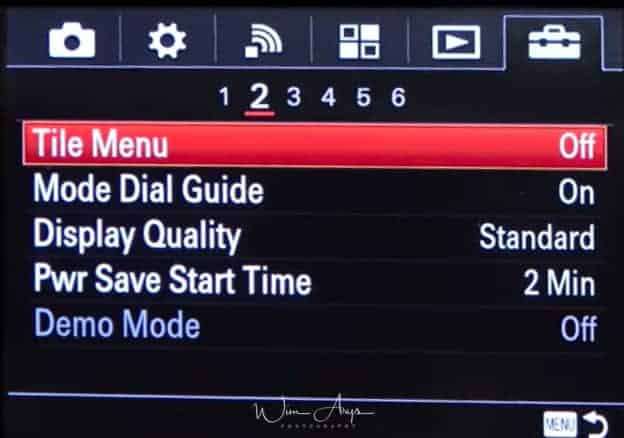
Championship Card
cull between tiles or a tiled forepart page when accessing the MENU or a direct tab manner carte layout.
Mode Dial Guide
You can brandish the description of a shooting manner when you lot turn the manner dial and change the settings available for that shooting way. Handy when yous are learning how to use the Sony DSC-HX400V.
Delete confirm
You lot tin set up whether Delete or Cancel is selected as the default setting on the delete confirmation screen.
Display Quality
You can modify the brandish quality. Fix to standard to preserve battery life.
- High: Displays in high quality.
- Standard: Displays in standard quality.
Pwr Save Start time
Selects the time it takes for the camera to go into sleep mode if you don't employ it.
Demo Mode
Demo mode is merely used in retail stores for demonstration purposes.
MENU – Setup – page three
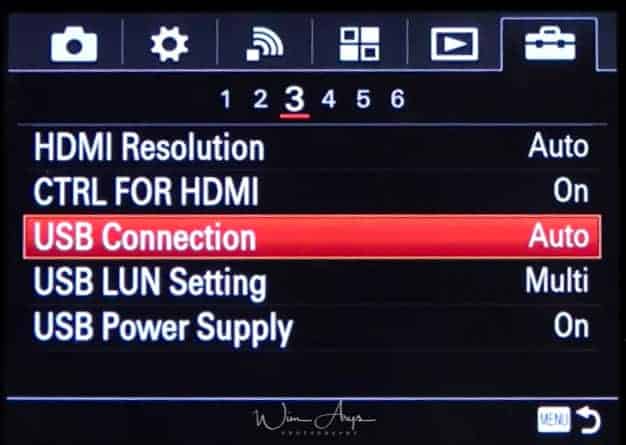
HDMI Resolution
When you connect the product to a High Definition (HD) TV with HDMI terminals using an HDMI cable (sold separately), you lot can select HDMI Resolution to output images to the TV.
- Motorcar (default setting): The product automatically recognizes an HD TV and sets the output resolution.
- 1080p: Outputs signals in Hard disk picture quality (1080p).
- 1080i: Outputs signals in HD film quality (1080i).CTRL for HDMI.
CTRL for HDMI
When connecting this production to a BRAVIA compatible Television set using an HDMI cable, yous can operate this production by aiming the Idiot box remote control at the Television.
Either ON or OFF.
USB connexion
Selects what will happen when you connect your camera to your PC or MAC.
- Auto (default setting): Establishes a Mass Storage or MTP connectedness automatically, depending on the estimator or other USB devices to exist connected. Windows 7 or Windows 8 computers are connected in MTP, and their unique functions are enabled for utilize.
- Mass Storage: Establishes a Mass Storage connection between this production, a calculator, and other USB devices.
- MTP: Establishes an MTP connection betwixt this product, a computer, and other USB devices. Windows seven or Windows 8 computers are connected in MTP, and their unique functions are enabled for utilise.
USB LUN Setting
Improves compatibility with external devices by limiting the functions of the USB connection.
Older devices that are non able to connect to the camera might work when set up to single. Otherwise, use Multi.
USB power supply
You can charge theSony DSC-HX400V via USB. This setting sets whether to supply ability via the micro USB cable when the product is connected to a computer or an USB device.
MENU – Setup – page 4
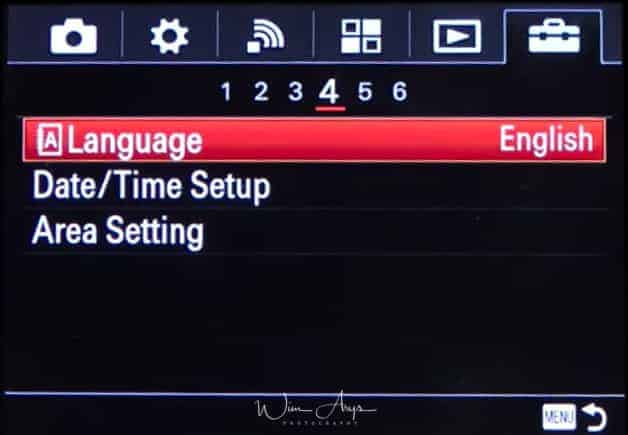
Language
Set your preferred language. The advantage of setting it to Eglish is that you'll find much more information online when you demand any troubleshooting.
Appointment Fourth dimension Setup
Change date, time, date format and Daylight savings time.
Area setting
Select your region, or change region when abroad, the camera will automatically change fourth dimension and engagement for you.
MENU – Setup – folio 5
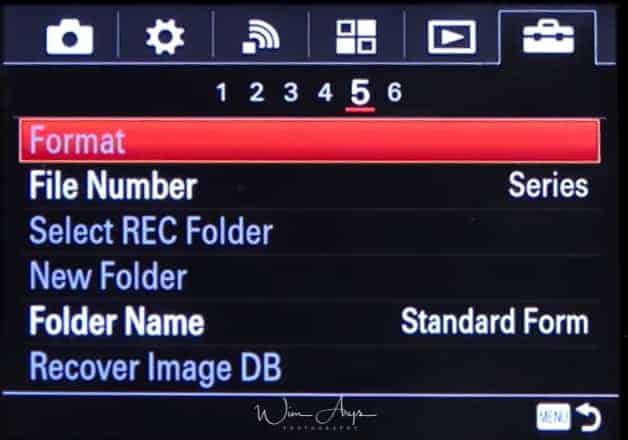
Format
Format your SD card before utilize; this will erase whatever images still on the memory carte.
File Number
Number your files according to a number of shots or reset it to starting time from ane.
Select REC folder
Selects where the camera volition shop newly captured images.
New Folder
Make a new binder for easily organizing events and locations
Folder name
Choose whether to have folder names in standard course (DSC) or create a new i past appointment. Setting folders by date will brand organizing your images easier.
Recover Prototype DB
If you have a storage card error, you tin endeavor to rebuild the database to mayhap call up lost images.
Carte du jour – Setup – page 6
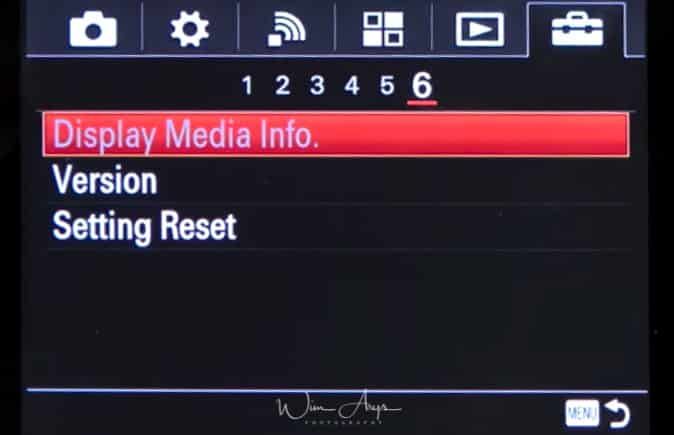
Display media info
Displays the recordable time of movies and the number of recordable nevertheless images for the inserted memory card.
Version
Check what version of the operating organization your camera and lens are running. Sony sporadically releases updates with new features, so it might be worth checking if whatever new firmware versions are available.
Setting Reset
Fully resets the camera to factory settings.
In the next affiliate, I'll go over all the functionality that I find near useful
Mode punch functions: what'southward the difference betwixt intelligent and superior auto?
Intelligent Auto
- This mode lets the camera detect what kind of scene you are photographing. It switches to the scene setting it finds most appropriate, including aperture, shutter speed, ISO, and AF mode.
- These unlike scene settings are the same yous'll find manually selectable in SCN mode.
- All Sony cameras practise a good job at detecting scenes, although the avant-garde photographer will prefer to shoot in Discontinuity, Shutter priority or fully manual mode in gild to have more than command over things like depth-of-field, motion, and focusing surface area.
Superior Auto
- Does the same scene recognition and (when the camera decides information technology is appropriate) adds hand-held twilight, anti-motility blur, and backlight correction HDR in order to optimize dynamic range, movement and exposure.
- It uses multiple images shot in close succession at high quality and combines them into 1 jpeg. Works well on stills but should not be used for movement.
Peaking
Peaking enhances the outline of in-focus ranges using a specific color in Manual Focus or Direct Manual Focus shooting.
- This works in MF and DMF focusing modes
- Bill of fare → (Custom Settings) → [Peaking Level] → desired setting.
- It displays a color selectable dissonance in the regions where the focus is on.
- A depression setting is recommended in plenty calorie-free on the Sony DSC-HX400V.
- In dim light, you might need to go to medium to get a expert idea of where the focus is at.
Lock-on AF
Depending on the options selected in [Focus Area] or [Center Lock-on AF], the available functions varies when pressing the key. Plant in the Focus Area setting. When you press the key when the [Focus Area] is prepare to [Wide] or [Eye] and [Center Lock-on AF] is [On], [Heart Lock-on AF] will actuate. The photographic camera will automatically focus while pressing the central when the [Focus Area] is [Wide] or [Center], [Focus Mode] is set to other than [Manual Focus], and [Center Lock on AF] is set to [Off].
- When y'all press the heart button, the photographic camera detects the subject positioned in the center of the screen and continues to track the bailiwick.
- MENU → (Photographic camera Settings) → [Lock-on AF] → [On]
- Align the target frame (A) over the subject field and printing in the center of the control wheel. Printing once more to terminate tracking.
- If the photographic camera loses track of the subject area, it tin find when the field of study reappears on the monitor and resume tracking.
- Printing the shutter button fully downwards to shoot the paradigm.
Smile/face detect
When gear up to On, The Sony DSC-HX400V will automatically detect and focus on faces. This is a very powerful feature.
Go to MENU → (Camera Settings) → [Smile/Confront Detect.] and select either:
- On : Automatically selects a face to be brought into focus.
- Smile shutter: Automatically detects and shoots a grinning. When the Smile/Face Find. is set to Smile Shutter, you can select the Smile Detection Sensitivity from Slight Smiling, Normal Smile or Big Smile.
Determination
Although the Sony DSC-HX400V compact camera is deemed an enthusiast oriented or 'beginner' camera, you'll find that it has many of the avant-garde features of the Sony RX and even ILC line. An advanced manual similar this tin help you make the most of information technology, and brand you a amend photographer. If y'all're just starting out in photography, I would suggest taking a look at the SCN or Scene selections that give you a practiced starting bespeak for any blazon of action or subject y'all'd similar to shoot.
In that location are many hidden features and functions like this inside the Sony HQ400V, and I would suggest taking some fourth dimension to learn some of them. I know that and advanced guide like this looks daunting at first, only you'll shortly go the hang of it by easily following along with your camera'southward bill of fare system.

Source: https://www.wimarys.com/sony-dsc-hx400v-advanced-manual-with-tips-and-tricks/
Posted by: mooreeareeter.blogspot.com
0 Response to "Can Image Stabilization On Sony Dsc Hx400v Be Repaired?"
Post a Comment